Win the fleet. The back office is already provisioned.
You own the client, the panel and the commercial terms. The record, the back office and the assistant carry the rest, so the book grows without a head per fleet you win, every contract stays evidenced, and the business you are building is worth more to whoever looks at it next.
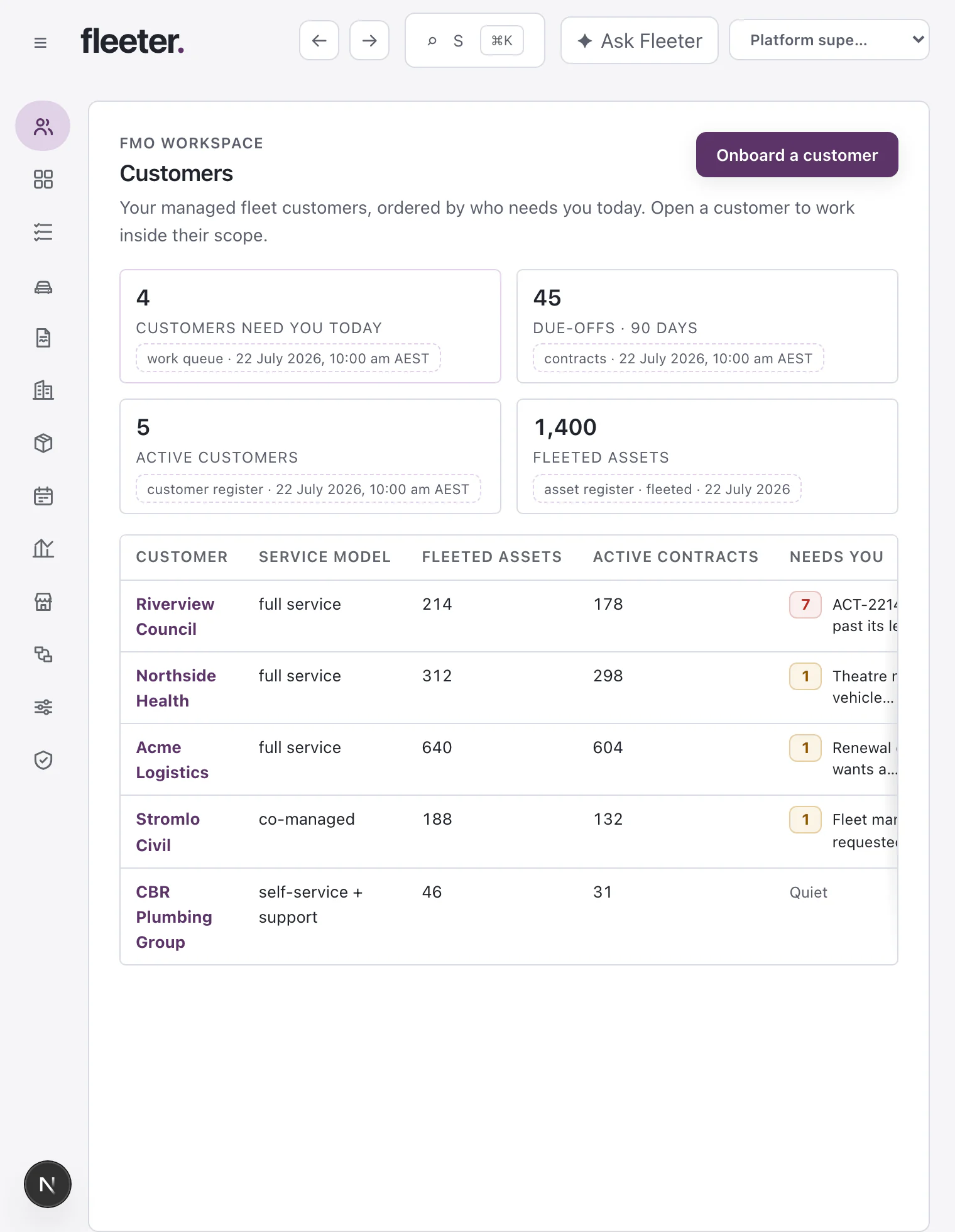
The whole book, as it is built. Sample data, not a customer’s.
Sales is not what is holding you back.
Every fleet you win creates a second problem. The onboarding buries a quarter of the team, the exceptions land on your best three operators, and the honest reason you hesitate on a big tender is that you are not sure operations can absorb it.
That is a back office problem wearing a growth problem’s clothes. Your people are currently the integration layer between ten counterparties who do not talk to each other, and there is no amount of process discipline that fixes an architecture.
- Vehicles per operations FTE, measured rather than assumed
- Touches per transaction, and where each one comes from
- Exception ageing by client, so the drag is visible before it is a complaint
- What cleared without a human, which is the number that should be growing
Everyone works the same record. Nobody sees more than their own.
Clients, drivers, dealers, workshops and auditors each get a scoped view of the same underlying vehicle and the same underlying transaction, under your brand. Your financier panel is worked from the same record too: one application, compared across the whole panel with an explainable rate build up, packaged and submitted by your team.
No forwarding PDFs. No status enquiry calls landing on your best operator. No reconstructing the chain for an auditor eleven months later, from four inboxes.
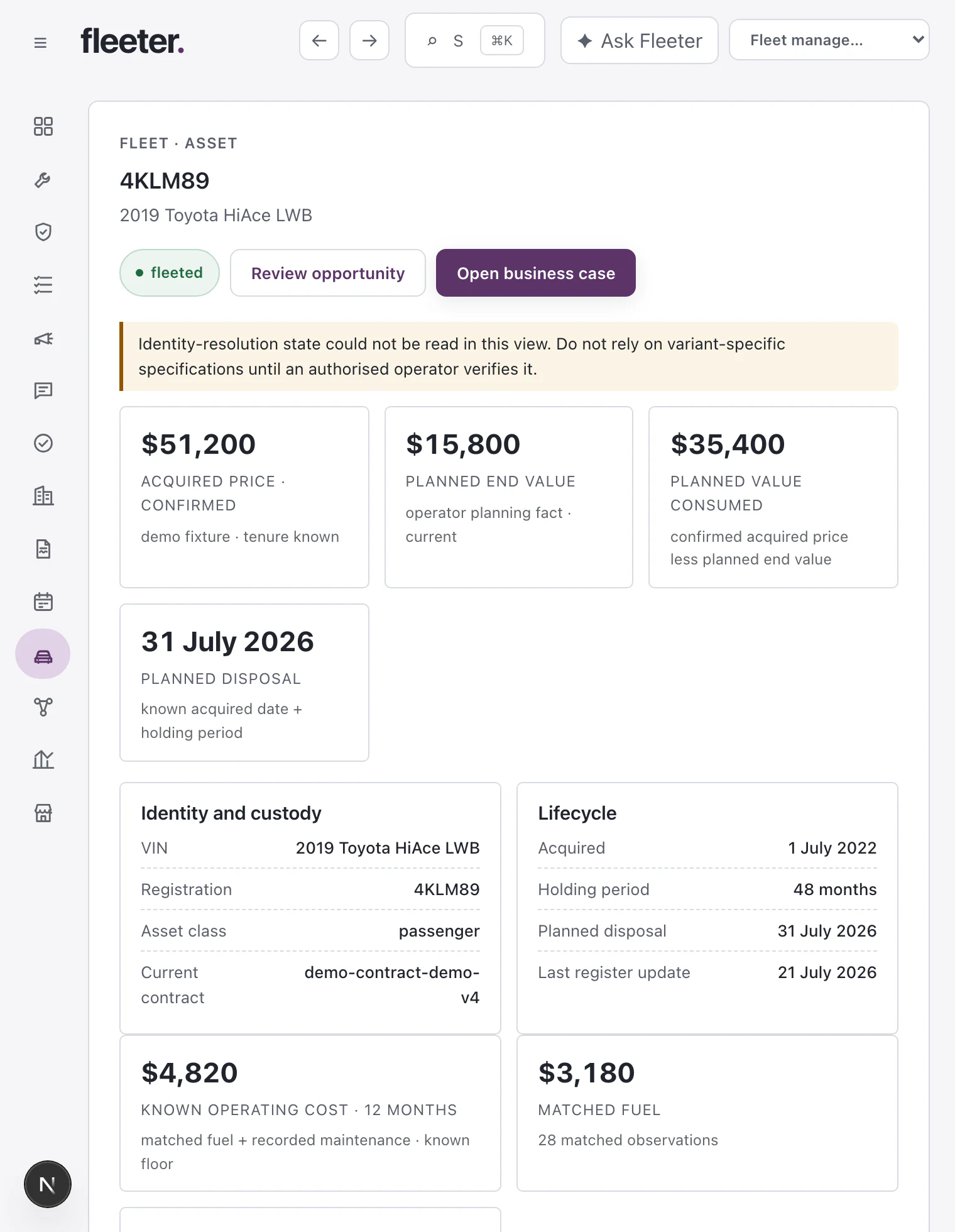
Their fleet comes in from the files they already have.
Onboarding used to be the quarter that buried the team. Here it starts from what the client can actually produce: a fuel card statement builds the register on its own, a spreadsheet register imports through a reviewed mapping as a job you can watch and stop, and a dump of everything else goes through census, extraction, golden record, variance and reconciliation with the source recorded on every field.
Nothing is guessed. An identifier the pipeline cannot resolve is kept as evidence and named for a person, never dropped, and every load is re-runnable from the same dump, so the rehearsal is cheap enough to do twice.
- BP, Ampol, Shell, WEX, Motorpass and depot bowser files read as they arrive
- Register imports with a reviewed mapping, chunked, receipted, stoppable
- Provenance on every extracted field: document, page and span
- A reconciliation the client signs before anything is promoted
Grow the book without the back office pressure.
The assistant works for your operation under your brand name. Your clients and their drivers can ask it plain questions and get answers from the part of the record their sign in can see, and nothing more. Anything it should not answer it hands to a person as a logged request, so the calls that reach your best operator are the ones that need one.
Inside the operation it acts only through a plan a person confirms: import these vehicles from the attached file, analyse this bill, rank candidates for this role. It is off for every tenant until you turn it on, read only first if you prefer, under a processing policy, retention and budget you set. A fully private model deployment is built in for organisations that require it.
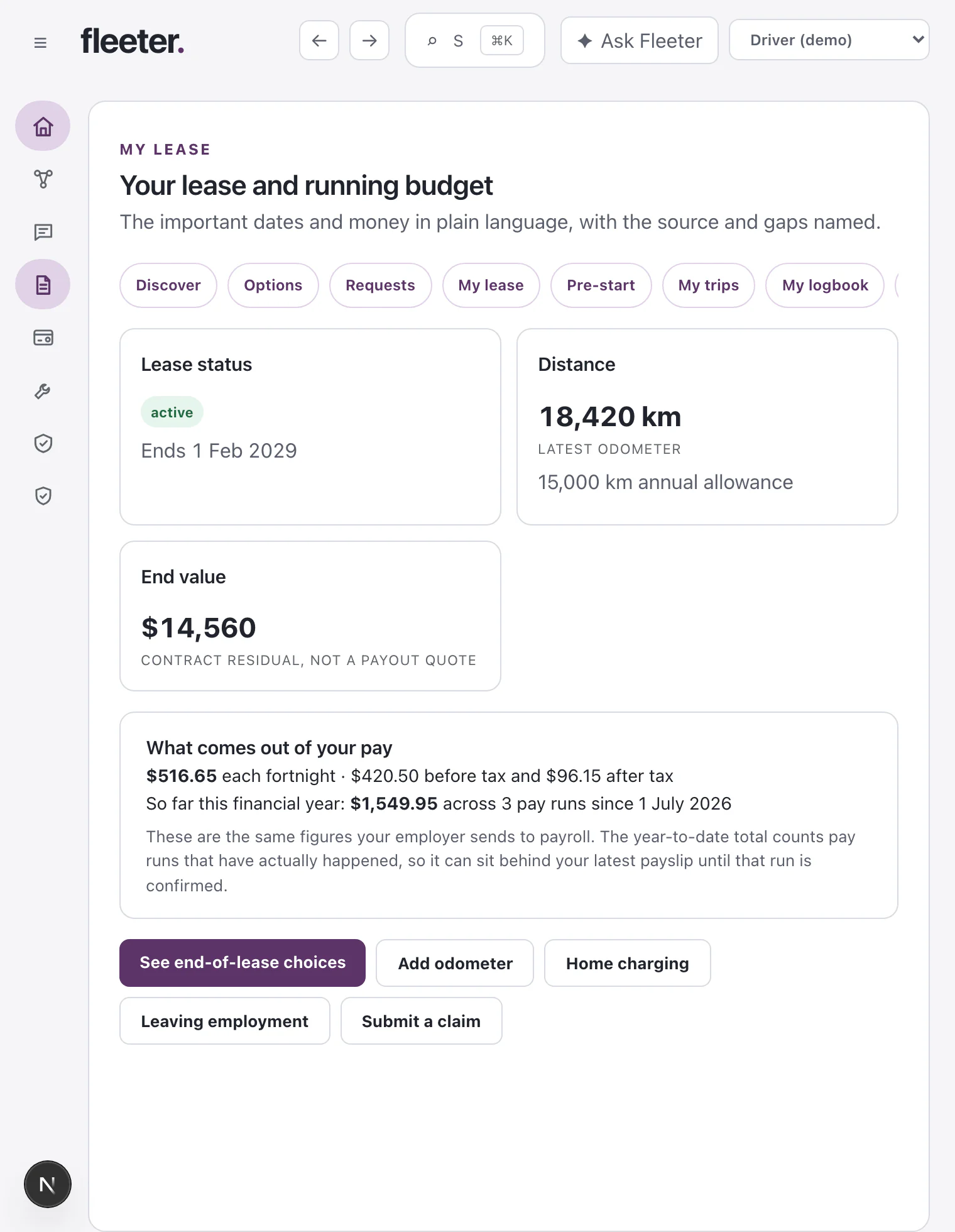
Migration without the horror story.
Re-platforming has a reputation in this industry and it is earned. Onboarding here runs on your real book, in named stages: a census of every source you hold, extraction, a golden record per vehicle, a variance report against the incumbent, and a reconciliation your client signs before anything is promoted.
Your client can see exactly what has moved and what has not. Going live is an approval you give on a Tuesday, not a weekend you survive.
The commercial half matters as much as the technical one. Migration is quoted as a fixed scope, a named list of source systems and a record volume, before you sign anything. What is not on that list is quoted separately rather than discovered later.
- Staged on real data, with a defect register you can audit
- Reconciled against the incumbent ledger before cutover
- Sources and volumes named in the quote, not estimated afterwards
- Your panel, your terms, your commercial model, configured rather than assumed
A book that is worth more because it can be proved.
A fleet management business is valued on what can be shown about its book: that every contract is what it says, that every vehicle is where the register says, that the panel terms and the client terms reconcile. Most operators build that picture for a buyer or a funder in a data room, at the moment it is worth least to be found wanting.
Here the proof is a by product of running the business. Every entry carries its source, nothing is edited, and the whole record exports in open formats whenever you choose. Compliance costs less along the way, and the business is easier to sell, to fund or to hand on.
Walk into every client review with something they cannot get elsewhere.
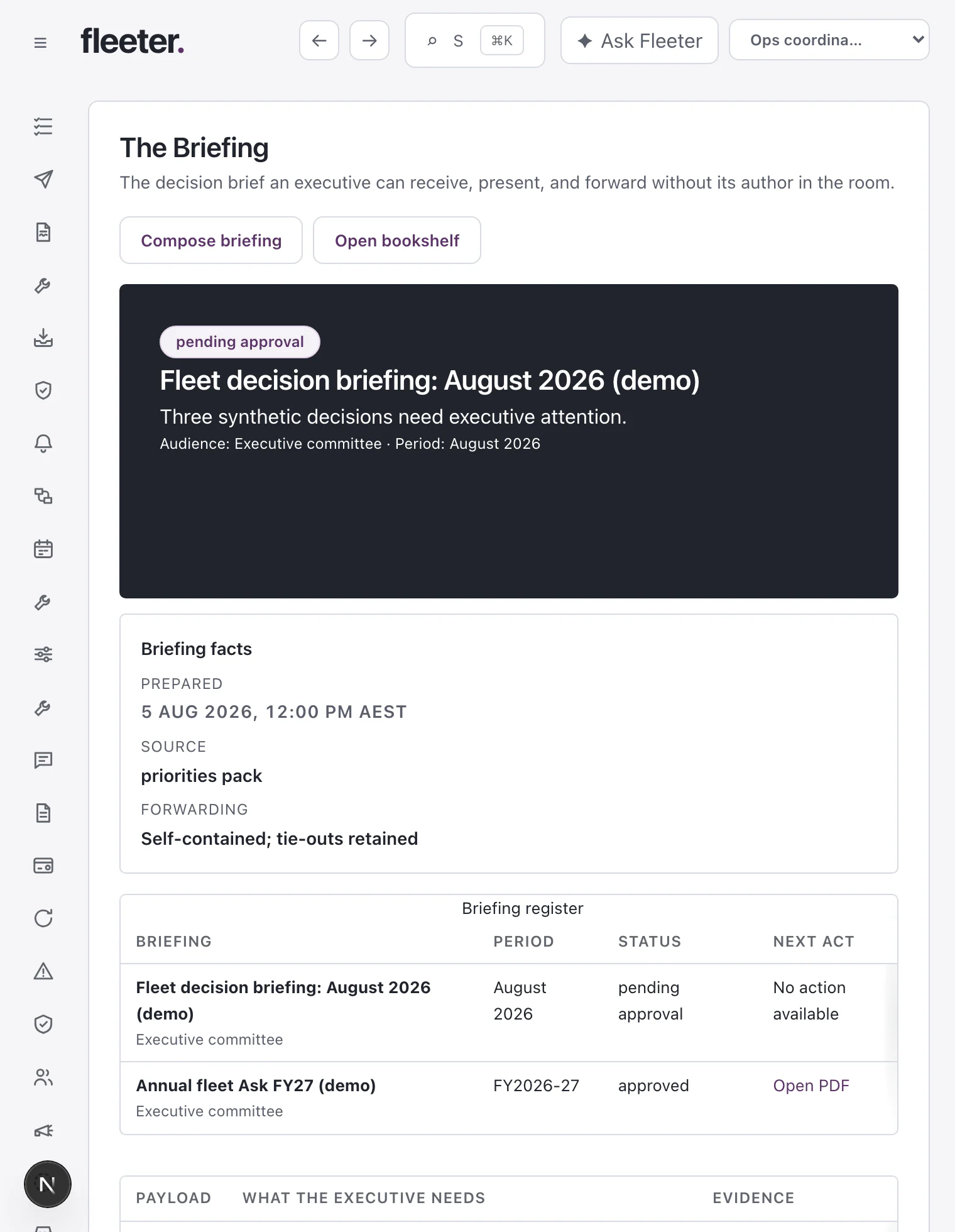
The planning layer becomes a deliverable you present under your own brand: a board ready briefing per client, generated from their real data, every figure traced to its source.
It is the artefact that wins the renewal, and it costs you the time it takes to choose the audience and the period.
Bring one client fleet. Anonymised is fine.
We will walk the lifecycle end to end on real shaped data, then measure your current vehicles per FTE, touches and turnaround on a sample book and hand you your own numbers. The operating baseline is $9,500, fixed scope, and it is credited in full against implementation.