The record that does your proving for you.
Everything the rest of this site promises, the briefing you did not build, the FBT year that is not an event, the car worth more at resale, comes down to one capability: when someone asks, the record answers, and shows where the answer came from. This page is how that capability is built.
Ask a simple question about a company car three years from now and you will usually get four different answers from four different systems, none of which can prove anything. The passport exists so that question has one answer.
- Service completed2 Aug 2026 · service_recordNorthline Automotive · 60,000 km · invoice hash recorded
- Assigned to a role6 Feb 2026 · assignmentWorks depot western · parks and maintenance run
- Registration renewed3 Jan 2026 · complianceACT · expires 3 Jan 2027
- Decision recorded18 Nov 2025 · decisionRetain to planned disposal · end value set · reasons recorded
- Acquired14 Mar 2023 · lifecyclePurchase · $58,420 confirmed · asset register import, hash recorded
- Acquired
- 14 Mar 2023
- Holding period
- 48 months
- Planned disposal
- 14 Mar 2027
- Odometer
- 61,284 km · 2 Aug 2026
- Last register update
- 11 Aug 2026
- Fleet manager
- the whole record
- Assigned driver
- their own vehicle and their own costs
- Workshop
- this job and this vehicle
- Supplier
- only the jobs it was invited to
- Auditor
- the record and its trail
Scoped at the database layer, audited on entry
The interface as it is built. Sample data, not a customer’s.
Four properties, and all four have to hold.
Drop any one of them and you are back to a system of record that stops being true the moment someone leaves, sells, or reorganises.
Through time
Nothing is edited. Everything is added. The record holds what happened and when, not just what is true this morning, so a question about 2024 has an answer in 2029.
Through the businesses that stand behind it
Every entry carries the business that attested to it: the workshop that certified the service, the supplier that fitted the part. That business attestation can travel with the vehicle. The people, invoice amounts and commercial terms behind it do not.
Through owners
Employer to operator to financier to dealer to whoever buys it next. Verified asset history crosses that boundary. Negotiated pricing, contracts, internal decisions and the people attached to the old arrangement stay with the organisation that owns them.
Through everyone who keeps it running
Workshops, insurers, registries, energy providers, auditors. Each can read or write only the part of the record their work requires, and no more.
Everything that is actually true about one car.
Not everything that could be recorded. What someone may need to prove, with access limited to the party entitled to see it.
- Identity
- VIN, registration, the catalogue variant it resolves to, and the evidence for each. When the VIN has not resolved yet, the record says so rather than guessing.
- Ownership and custody
- Which organisation owns it, which one holds it, which site or role it is assigned to, and when each of those changed. Effective dated, so a question about last March gets last March’s answer.
- Commercial record
- Acquisition and operating costs, built from matched evidence rather than allowances. Visible only inside the current authorised organisation; not part of the history transferred with the vehicle.
- Contract
- The lease or loan it sits under, its terms, maturity and residual position. Restricted to the parties to that arrangement.
- Service and condition
- Every job, workshop and supporting invoice, content hashed, with each entry carrying the party that certified it. The transferable history carries the service attestation, not the invoice price or negotiated rate.
- Compliance
- Registration, roadworthiness, declarations, and the obligations attached to how it is used.
- Use
- What the vehicle did as an asset: distance, load, duty pattern, energy. Aggregated to the vehicle and its role, never assembled into a picture of somebody’s week.
- Value
- What it is worth now, on a method that is stated, and what the record says the next buyer is getting.
Nothing in the record is edited. Corrections are added.
Four rules.
Append only
A record is added, never overwritten. A wrong entry is corrected by a new entry stating what changed and which party changed it, which means the history of the history survives too.
Sourced or absent
Every figure carries where it came from. Where the evidence is partial, the screen says the number is a floor and not a total. A number without a basis is not shown at all.
Scoped at the core
Who can read which part is enforced inside the database, not in the application. A workshop sees its job. A driver sees their car. Crossing that line is not a permission, it is a structural impossibility.
Verifiable
Documents are content hashed. Snapshots are signed and byte preserved. You can hand the record to an auditor and they can check it rather than trust it.
A record of a vehicle, not of a person.
This boundary is deliberate and it is enforced in the design, because a record that follows a car for fifteen years must never become a record that follows a person.
- What travels with the vehicle
- The asset identity, verified service and condition history, odometer evidence, compliance status and the businesses that attested to those facts. A workshop’s certification can travel so the next owner can rely on the work. Its invoice amount, negotiated rate and discount do not.
- What stays behind, on both sides
- People and commercial terms. Not the driver, approver or coordinator; not purchase or lease pricing, panel rates, rebates, discounts or margins. Your internal accountability and commercial records stay complete inside your own organisation, where they belong.
- Not a journey history
- Usage sits against the vehicle and its role: distance, load, duty pattern, energy. The passport is not a movement history and cannot be read as one, which means it is no use to anybody trying to work out where a person has been.
- Enforced, not promised
- This is not a paragraph in a policy. Which party can read which part of the record is enforced inside the database, so a buyer looking at a de-fleeted ute has no route to anything about whoever used to drive it.
The people who keep the car running, not a data entry team.
A workshop completing a service is the only party who genuinely knows what was done to the car that day. So the workshop writes it, in the course of getting paid, and the entry becomes part of the vehicle for the rest of its life. That is the whole trick: the record is a by product of the work, not a second job.
The interface as it is built. Sample data, not a customer’s.
The record is the thing the next owner is buying.
Two identical utes, same age, same kilometres. One arrives with a complete, tamper evident history: every service, every odometer reading, the chain of owning organisations, and the gaps labelled where they exist. The other arrives with a logbook and a promise. They are not the same asset, and the market has always known it. What has been missing is a way to prove which one you are looking at.
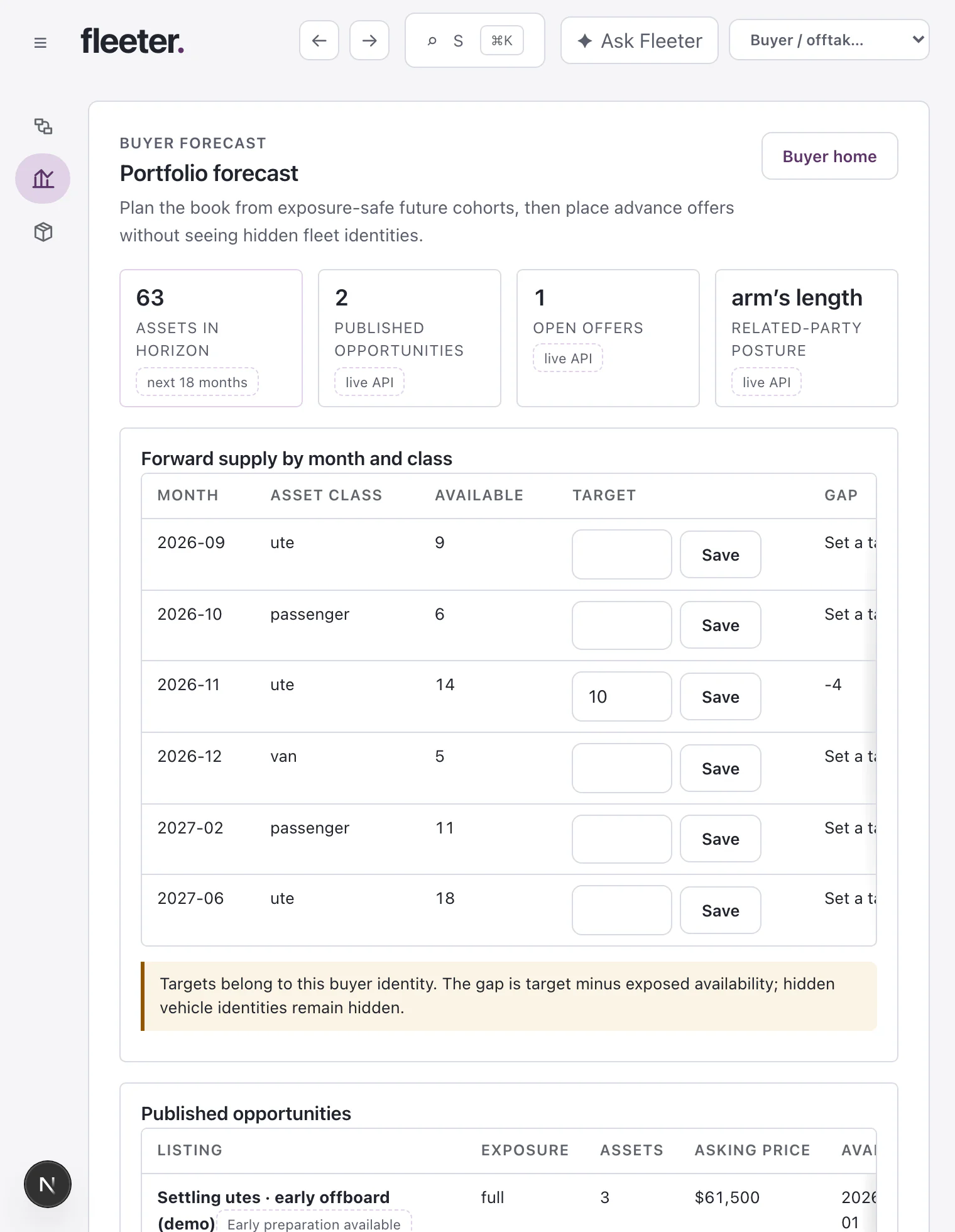
The interface as it is built. Sample data, not a customer’s.
See your own vehicles in it.
Bring a fuel card statement, or one VIN and a service history. We will build the record and show you what it already knows.